
67% of B2B buyers say they prefer to complete a purchase with no sales rep involved at all - Gartner, n=646, fielded August - September 2025. That number is why the phone number is quietly leaving European product pages, and it does not say what the people moving it think it says.
Here's the other half. The same research house reports that purchase regret among customers who prefer a rep-free experience runs 23% higher than among customers who interact with a sales rep. That is Gartner's exact comparison, published in a release from May 2021.
One house, separate waves. Not two independent findings - and that matters as much as either number.
The cost of an unanswerable SKU doesn't land in conversion rate. It lands in returns, credit notes, pre-dispatch amendments and the customer who doesn't come back. You aren't measuring it there, which is why the decision keeps feeling free.
Nobody decides to remove the phone number
It happens in smaller moves. The number comes out of the header because it was cluttering mobile. The product page gets a "request a callback" form instead, because forms are trackable. The contact page goes two clicks deeper in a nav redesign. Out-of-hours the line rings out, and nobody calls that a decision either.
What you end up with is a catalogue where the €40 consumable and the €2,400 configurable unit have exactly the same contact route: none, or one that takes 48 hours to answer.
That's the bit worth arguing about. Not whether self-service is good - it obviously is, for most of your catalogue. Whether you've applied a whole-catalogue policy to a set of SKUs where a four-minute conversation is the difference between a shipped order and a returned one.
The 67% is what makes operators think that's safe. So let's take it apart properly, because I'd rather you distrust this post than trust it lazily.
Where does the 67% actually come from?
It's real, it's recent, and it's thinner than the slide you saw it on.
Gartner surveyed 646 B2B buyers in August - September 2025 and published the figure in a press release on 9 March 2026. That release is one paragraph of method: sample size and fieldwork months, nothing else. No "about the survey" block, no weighting, no country list. The trade press picked it up a week later - a faithful secondary, not an independent measurement of anything.
Gartner does not disclose which countries were sampled. Not this wave, not any wave in the series. You're European. There is no European-specific version of this number, and I'm not going to pretend the 67% is a German or Italian or Dutch figure, because nobody knows whether it is.
What the 67% is, precisely
- The rep-free preference figure comes from Gartner's survey of 646 B2B buyers, fielded August - September 2025 and published 9 March 2026.
- Gartner does not disclose the countries sampled in that wave, or in any wave of the same series, and publishes no methodology section with it.
- No European-specific version of the figure has been published. For a European operator it is directional evidence, not a local benchmark.
Same wave, same n: 45% of those buyers used AI during a recent purchase. Buyers now arrive further along, having asked a model the questions they used to ask you - and having got answers about your products that nobody at your company checked.
Two stats, one research house: what that changes
This post's premise is "don't act on an unexamined headline", so it doesn't get to rest on one either. Here's the sourcing in the open.
| Finding | Source | n | Fieldwork | Notes |
|---|---|---|---|---|
| 67% prefer rep-free | Gartner, March 2026 release | 646 | Aug - Sep 2025 | countries not disclosed |
| 23% higher purchase regret among buyers who prefer rep-free, vs buyers who interact with a rep | Gartner, May 2021 release | not stated | not stated | countries not disclosed |
| Buyers want ~3.0 activities both online and with a rep, vs 2.3 rep-only and 1.8 digital-only | Gartner, June 2025 release | 632 | Aug - Sep 2024 | averages across all buyers, not segment sizes; countries not disclosed |
| Rule of thirds: in-person / remote / digital self-serve | McKinsey B2B Pulse | ≈4,000 | 13 countries | corroborates direction only |
Verified against the primary releases, July 2026.
These are not two independent findings. One research house, three releases, at least four separate surveys. If Gartner's sampling frame tilts, every row above tilts with it.
The regret figure is the weakest number here, and I'll say so before someone else does. Gartner published it in May 2021. The release attaches no sample size, no fieldwork window and no country list to that specific finding. It describes two other surveys - one of nearly 1,000 B2B customers in November - December 2020, one of more than 1,100 in December 2020 - and ties neither of them to the 23%. So: no n, no countries, no stated fieldwork date, and a release built on research conducted in the months when the buying behaviour of the entire market was distorted.
And read the comparison precisely, because almost nobody does. Gartner contrasts customers who prefer a rep-free experience against customers who interact with a rep. That is a comparison of preference groups. It is not a comparison of two checkout paths, and it is not a measurement of what happens to an order that goes through with nobody on the other end of a phone.
The headline itself moves between waves. Gartner's June 2025 release put rep-free preference at 61% (n=632, fielded Aug - Sep 2024). The March 2026 release put it at 67% (n=646, fielded Aug - Sep 2025). Separate releases, separate waves, different numbers. If you took the phone number down on the strength of one figure, you took it down on a moving object.
McKinsey corroborates the shape, not the arithmetic. Its B2B Pulse rule of thirds - at any given stage of the buying journey, a third of buyers want in-person contact, a third want remote, a third want digital self-serve, and that split holds across geography, industry, company size and deal value, n≈4,000 across 13 countries - supports the claim that a large, stable share of buyers wants human contact. It confirms no number on this page. Nothing here gets to claim two-source verification of a figure.
So the case for keeping the line answerable doesn't rest on the 23%. The 23% is a reason to go and check your own data, which for this question beats Gartner's: it's yours, it's at order level, and it's about your SKUs.
Does going unanswered actually cause regret?
Honestly: you can't tell from this data. It isn't built to answer that.
Start with what Gartner actually compared: people who said they'd rather not deal with a rep, against people who dealt with one. Those two groups can differ in a dozen ways that have nothing to do with whether anyone picked up - seniority, experience with the category, how much they'd already decided before they started. Then add the obvious confound: harder, more expensive, more configurable purchases plausibly pull in a human and generate more regret on their own. Same 23%, no causal link. Anyone selling you the stat as proof that self-service causes regret hasn't read the sentence.
That doesn't get you off the hook, because both readings land in the same place. If going unassisted causes regret, making complex orders unanswerable costs you money. If complex purchases simply generate both, then the complex orders currently going through with nobody reachable are precisely the ones carrying the exposure. Either way: don't make the orders where getting it wrong is expensive the ones you can't be reached about.
"Regret" isn't a line in anyone's P&L. In an ecommerce business it surfaces as returns, cancellations before dispatch, order amendments, credit notes, arguments about whether the thing was ever specified right, and the expensive one nobody attributes back to the original order - the customer who doesn't come back.
Worth flagging once, plainly: this is B2B buyer survey data. Stated preference from buying committees, not order-level ecommerce data. It maps onto high-ticket, configurable, multi-step purchases - HVAC systems, spare parts with fitment risk, medical and dental equipment, industrial supply. It does not map onto a €40 consumable someone reorders monthly.
Buyers want a hybrid path. The phone is the cheapest one you can offer.
This is the only structural finding in the whole dataset, and the headline buries it.
In Gartner's August - September 2024 wave (n=632), buyers wanted to complete more of their buying activities both ways than either way on its own.
How buyers want to complete a buying activity - average activities per buyer
Source: Gartner, June 2025 release - n=632, fielded August - September 2024. Averages across all buyers, not segment sizes. Countries not disclosed.
 © 2026 Sabato LTD · sabato.ai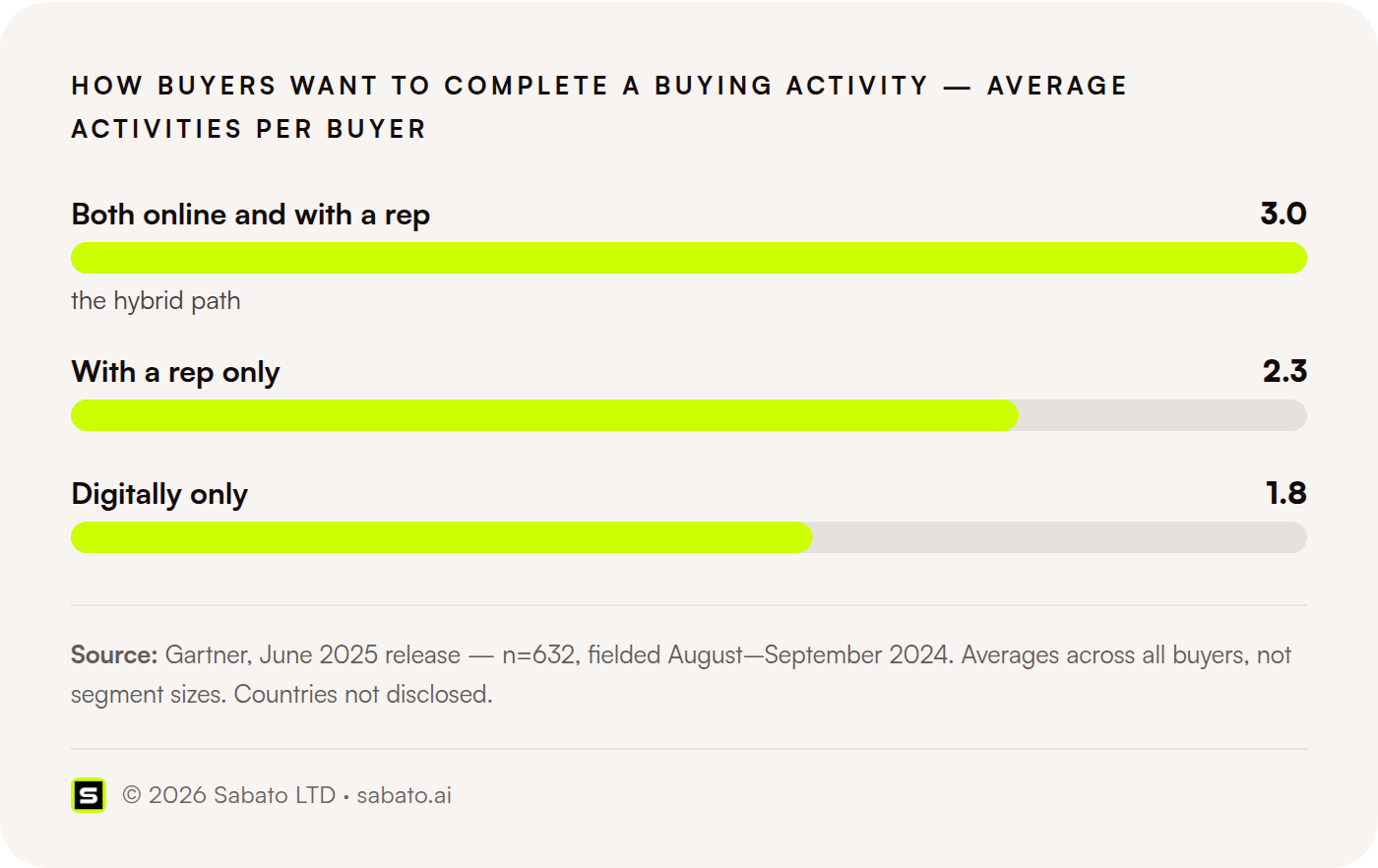
These are averages across all 632 buyers, not the sizes of three buyer segments. The same buyer contributes to all three rows. What the numbers say is that the hybrid mode is where buyers want most of their purchase to happen - more of it than they want in either pure mode.
Read that as a sentence about control, not headcount. "I prefer to complete the purchase without a rep" is a statement about who drives the process. It is not a statement about whether anyone answers when the process breaks. Buyers want to run the purchase themselves and want someone reachable for the two or three steps where self-serve falls over: fitment, lead time, spec confirmation on a configurable item.
Now the practical part. If buyers want a hybrid path, you have to build one, and your options are not equal. A named account rep on high-ticket SKUs is real money per order. Live chat staffed by someone who can actually answer a fitment question is real money per hour, and unstaffed chat is a form dressed up as a conversation. Field visits are for deal sizes most of this audience doesn't run. A working phone number costs you the marginal minute of whoever picks up, requires no new tooling, and handles the two questions that block a configurable order faster than any other channel because the buyer can ask a follow-up in the same breath. That last sentence is my reasoning, not a Gartner finding - but it's the reasoning that decides where the hybrid path gets built.
McKinsey points the same way from a much larger, 13-country sample: at any given stage of the buying journey, two of the three thirds want a human in the loop - one in person, one remote - and that split holds across geography, industry, company size and deal value. On a B2B purchase, "remote human" is overwhelmingly a call. That's my inference, not McKinsey's wording. But if a third of your demand at any given stage wants remote human contact and your only route is a form with a 48-hour reply, that's a structural mismatch, not a staffing preference.
Burying the number doesn't remove the need. It reroutes it - into the enquiry form nobody staffs, into an abandoned call on the sales line, or into an order placed on a guess that comes back as a return.
And being reachable is not the same as being pushy: answering is the opposite of outreach nobody asked for.
This is a returns line, not a conversion line
Make a high-ticket configurable SKU unanswerable and you get a small, visible, immediate conversion gain - fewer clicks, fewer exits to a contact page, a tidier funnel. You also get a larger, invisible, delayed cost in returns, credit notes and customers who don't reorder.
The conversion gain is instrumented by default in every analytics stack on earth. The regret cost is instrumented nowhere. That asymmetry - not the underlying trade - is why operators keep burying the number and keep believing it worked.
Look at the shape of it on a €2,400 configurable order. When that comes back you pay the reverse logistics, the restocking or write-down on a configured item that may be unsellable as built, the credit note, and the customer. Set that against the marginal orders you won by removing a click. That's the structure of the comparison, not a benchmark - and most operators can't tell you what one of their returns actually costs, which is the first thing to go and find out.
Not the same mechanism as bracketing, which is deliberate buyer behaviour with a known fix. A regret return on a configurable good is a question the buyer never got answered. Same P&L line, different cause, different remedy.
And the exposure is growing at the top end, because the online ticket ceiling moved. Orders that used to pass through a conversation by default now don't.
How to measure it on your own orders
Gartner compared preference groups. You can do better on your own book, because you can compare what actually happened: the orders where a conversation took place, and the orders where one didn't. The returns question settles in a quarter with data you already have. The repeat-rate question takes a year.
Tag the orders
An order is assisted if a real two-way conversation with a human happened before dispatch: an inbound call, a callback, a chat or WhatsApp thread a person actually replied in. Everything else is unassisted.
I'd keep templated quote emails and auto-replies out of the assisted bucket. They're a document, not a conversation, and the whole question here is whether talking changes the order - so if you want to keep them, give them a third bucket and read it separately. My reasoning, not a finding.
Two rules do the heavy lifting. The tag attaches at order level, not customer level - the same buyer can place one of each in a week. And a conversation that happens after the order does not make it assisted: that contact is the outcome you're measuring, not the treatment. Get it wrong and your assisted cohort fills up with orders that already went wrong, which guarantees a nonsense result.
If the flag doesn't exist natively - it usually doesn't - the practical sources are the phone system's call log matched on number, the shared inbox matched on email domain, and the quote reference carried on the order. Expect the phone match to be the leaky one: people ring from mobiles that aren't on the account. Where you can't match confidently, exclude the order rather than defaulting it to unassisted, and report how many you dropped.
The definition to write down
- An order counts as assisted if a real two-way conversation with a human happened before dispatch - an inbound call, a callback, or a chat thread a person actually replied in.
- Templated quotes and auto-replies do not count. Everything else is unassisted.
- The tag sits at order level, not customer level, and a conversation that happens after the order does not count: that is the outcome being measured, not the treatment applied.
Pick the proxies
- Return rate, in units and in value. Value matters more.
- Order amendment rate before dispatch. Cheapest, earliest, most under-used signal you have.
- Cancellation rate inside your own cancellation window - whatever window you have chosen to offer, say 30 days, read purely as a finance line. This is your commercial policy and nothing else.
- Repeat-purchase rate at 6 and 12 months. Slow, expensive, and the one that actually moves enterprise value.
Number 2 is your leading indicator. An amendment before dispatch is a customer catching a regret-shaped error before you ship it - usually the exact error a two-minute call would have caught first. If unassisted orders amend more, you have your answer months before the returns data confirms it.
One exclusion before you read anything: strip out the abuse cohort. Not every return is regret, and a chunk of what you're looking at is a different problem entirely.
Control the obvious confound
This is where most operators get a wrong answer.
Orders with a conversation attached are not a random sample. They skew larger, more configurable, more complex, toward more anxious buyers. Compare raw assisted against raw unassisted and you will "discover" that talking to customers causes returns. You will be wrong.
Minimum controls: same category, same ticket-size band, same period, new and returning customers separated. In practice that means building the comparison inside each cell rather than across the whole book - category × ticket band × customer type - and only then looking at the assisted/unassisted split within the cell. If assisted volume is thin, band wider and accept that you're getting a direction rather than a number.
Be blunt with yourself about power, too. Fewer than a few dozen assisted orders in a cell and you have a hypothesis, not a finding. Don't rebuild your phone rota on twenty orders.
Read the result
| What you find | What it means | What to do |
|---|---|---|
| Unassisted returns materially higher within band | Those SKUs need an answerable line | Put one back, run a quarter, re-measure |
| No difference | Your self-serve information is good enough for that category | Leave it alone, spend the money where it does something |
| Assisted returns higher within band | Your line is a rescue channel for bad product data - people ring because the site is wrong, and the order still goes out wrong | Fix the stock and lead-time data. Answering more calls is the most expensive way to not fix it |
Where the number goes back
Not everywhere. Reachable-on-everything is how you end up with a contact centre you can't afford at your volume, which is an arithmetic problem before it's a service problem, and worse again across multiple language markets.
Prioritise by regret exposure: high ticket, configurable, irreversible, infrequent buyer. HVAC sizing. Spare-part fitment. Appliance dimensions and lead times. Industrial and dental spec matching. On those SKUs the number belongs on the product page, next to the configurator, at the moment the buyer hits the question they can't answer - not on a contact page three levels down. On low-ticket, standard, high-repeat SKUs, leave self-serve alone. It works, and buyers say so.
The honest counterpoint, and it's the real reason operators bury the number: reachability creates demand. Put it back and calls arrive, including out of hours, including during the spikes where you'll drop calls. A number that rings out is worse than no number, because you've now promised something. This is a capacity decision, not a design decision.
Which is the gap a voice layer is for - keeping the line answerable on high-ticket configurable SKUs without staffing a phone team your volume can't justify. We sell one, so read that with the appropriate suspicion: a company arguing that answering the phone matters, which happens to sell a way to answer the phone. The limitation is the part I'd want to hear if I were on your side of the table. A voice layer that can't read live stock, lead time and fitment out of your ERP will give a confident wrong answer at speed, and generate exactly the return you were trying to prevent. Data problem before it's a voice problem.
What would change my mind
Four things, none of which exist publicly today. A replication of the regret differential by a second research house - recent, multi-country, European sampling disclosed. An order-level dataset instead of stated preference: what buyers did, not what they said, and compared by whether a conversation happened rather than by preference group. A version of the finding from ecommerce rather than B2B buying committees. And a disclosed sample and fieldwork window attached to the 23% itself, from a year that isn't 2020.
Any one of those pointing the other way and I'd drop the argument. Until then, the strongest evidence available to you isn't Gartner's. It's the split above, run on your own orders - which tells you what an unanswered SKU costs in your catalogue instead of in an undisclosed set of countries.
FAQ
Should I remove the phone number from my ecommerce site?
Not from high-ticket configurable products. Gartner's August - September 2024 wave (n=632) found buyers want to complete an average of 3.0 buying activities both online and with a rep - more than with a rep alone (2.3) or digitally alone (1.8). Removing the contact route doesn't remove the need; it reroutes it into unanswered forms and returned orders. On low-ticket repeat SKUs, self-serve is fine.
Do B2B buyers really prefer to buy without talking to a sales rep?
67% say they prefer a rep-free experience - Gartner, n=646, fielded August - September 2025, published 9 March 2026. Gartner does not disclose which countries were sampled and publishes no methodology beyond sample size and fieldwork months. The preference is real, but it describes who drives the process, not whether anyone should answer when self-service fails.
Does buying without a rep increase purchase regret?
Nobody has shown that. What Gartner reports is that purchase regret among customers who prefer a rep-free experience is 23% higher than among customers who interact with a sales rep - a comparison of preference groups, not of checkout paths. It comes from a release published in May 2021 and carries no sample size, no country list and no stated fieldwork window. One house's view, five years old. Check it against your own return data.
How do I measure whether an unanswerable product page is costing me returns?
Tag every order as assisted (a real two-way conversation with a human before dispatch) or unassisted, then compare return rate, pre-dispatch amendment rate, cancellations inside your own cancellation window, and 6-month repeat rate across the two. Control for category and ticket size: assisted orders skew larger and more complex, and an uncontrolled comparison will mislead you.
Is there European data on rep-free buying and purchase regret?
No. Gartner does not disclose the countries sampled in any of the relevant waves. McKinsey's B2B Pulse (n≈4,000, 13 countries) corroborates the direction - at any given stage of the journey, a stable third of buyers want in-person contact and another third want remote - but not the specific figures. European operators should treat all of it as directional and instrument their own orders.